Expressive Arts Therapy Training: What It Involves
Some forms of understanding arrive before words do. A gesture, an image, a movement across a room can hold what a sentence struggles to reach. Expressive arts therapy training is built on that recognition, and it prepares people to work with the creative process as a path toward healing and growth.The training brings together several art forms, visual art, movement, drama, music, and writing, and treats them as related ways of working with human experience. This article walks through what expressive arts therapy training involves, the practices it draws on, and the settings in which the work takes shape.
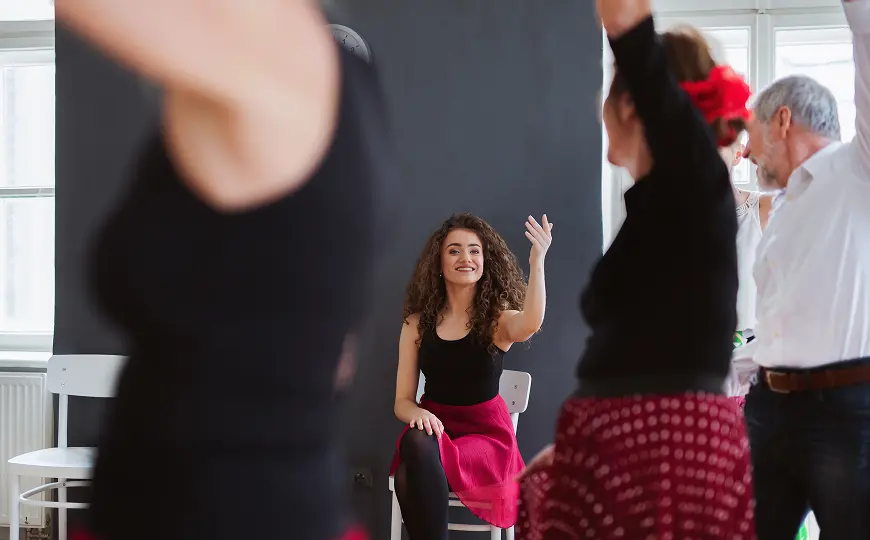
A group session unfolds through movement and gesture.
What Expressive Arts Therapy Training Is
Expressive arts therapy training prepares practitioners to use creative expression in service of wellbeing. The work rests on a simple idea with deep roots: the process of making something, an image, a movement, a sound, can open access to feeling and meaning that talk alone sometimes leaves untouched.This is a multimodal practice. Rather than specializing in a single medium, expressive arts work moves between forms, drawing on visual art, movement, drama, music, and writing as the moment calls for them. A systematic review of the field across these five modalities found the research base still developing, with enough quality findings to indicate real benefits from expressive arts therapies. The work has a recognizable shape across settings, even as the particular art form shifts.Good training develops both the practitioner and their craft. Students learn the methods, and they also do the creative and reflective work themselves, since guiding another person through the expressive process draws on having moved through it firsthand.
“[It’s been] a really beautiful experience at Meridian to dive into putting my whole being into the learning process and, instead of just listening to a lecture or reading a book, actually experiencing the learning process in my body, in my mind and my expression.”
Expressive arts therapy training engages a distinctive set of practices: body metaphors, art as therapy, embodiment, psychodrama, and work with trauma, including historical trauma. Together, they give a clear picture of the work.Each opens onto a way of working:
Embodiment and body metaphors. The body holds experience, and movement gives that experience a form it can be worked with. Training develops a practitioner's attention to what the body expresses and how movement can shift it
Art as therapy. The act of making, in itself, carries healing potential. Research on the field distinguishes this "art as therapy" tradition, where the creative process and its relaxing, ordering qualities do much of the work, from approaches that use the artwork mainly as a starting point for reflection
Psychodrama and enactment. Drama and role allow a person to step into experience, try new responses, and see a situation from the inside in a way that description cannot reach
Working with trauma, including historical trauma. Arts-based and body-based methods offer routes toward difficult material that can be gentler and more bearable than direct verbal approaches
Research on related arts-based methods helps explain why these practices work. A systematic review of art therapy for anxiety in adults described how the creative process can induce a flow-like, relaxing state, make inner material visible so it can be reflected on, and create a safe space for expressing difficult emotions and memories, supporting the regulation of stress, emotion, and thought.
How the Training Is Structured
Expressive arts therapy training is most often pursued at the graduate level, as part of a master's or doctoral program or through focused graduate study within one. Coursework combines experiential learning, where students engage the art forms directly, with the study of human development, psychological theory, and the principles that guide ethical, skillful practice.The experiential emphasis matters. A practitioner learns expressive arts work largely by doing it, in groups, in movement, in image and enactment, building the personal range they will later draw on with others. Training of this kind tends to weave together several threads:
Direct, experiential engagement with the expressive and movement arts across multiple forms
Grounding in human development and an interdisciplinary approach that informs the work
Attention to the practitioner's own growth, self-awareness, and creative range
Supervised or applied practice that connects the method to real settings
This structure suits people already established in their working lives. Much expressive arts training is designed for working professionals who study while continuing to practice, often through online or hybrid formats that make graduate study reachable alongside existing commitments.
Where the Training Leads
Expressive arts therapy training opens onto work in a range of settings, most commonly conventional healthcare settings, coaching practices, and employee wellness programs. These give a good map of where the work takes shape.In healthcare settings, expressive and movement arts support people working through illness, recovery, and the emotional dimensions of care. In coaching practices, the methods help clients access creativity, work with what holds them back, and move toward growth. In employee wellness programs, expressive and movement arts contribute to wellbeing, resilience, and the health of teams and the people in them.Across these settings, the practitioner brings the same core capacity: the ability to use creative and embodied processes to help people express, integrate, and grow.
Expressive and Movement Arts at Meridian
Meridian University offers the Expressive and Movement Arts concentration within its graduate degrees, with coursework aligned to professional practice in conventional healthcare settings, coaching practices, and employee wellness programs. The concentration engages practices including body metaphors, art as therapy, embodiment, psychodrama, and historical trauma, with sample courses such as Play, Imagination, and Healing; Expressive Arts in Groups; Movement Practices and Cognitive Development; Myth, Ritual, and Expressive Arts; The Poetic Body; and Expressive Arts in Therapy.The concentration sits within Meridian's broader approach to graduate education, which takes a holistic and integral perspective and treats the development of the whole person as central. Students engage the art forms directly, study the human development that underlies the work, and grow in their own creative and reflective capacity.For those drawn to this path, a conversation with an Admissions Advisor can offer clarity about program pathways and areas of focus.
References
Abbing, A., Ponstein, A., van Hooren, S., de Sonneville, L., Swaab, H., & Baars, E. (2018). The effectiveness of art therapy for anxiety in adults: A systematic review of randomised and non-randomised controlled trials. PLOS ONE, 13(12), e0208716.
Dunphy, K., Mullane, S., & Jacobsson, M. (2014). The effectiveness of expressive arts therapies: A review of the literature. Psychotherapy and Counselling Journal of Australia, 2(1).
Knill, P. J., Levine, E. G., & Levine, S. K. (2005). Principles and Practice of Expressive Arts Therapy: Toward a Therapeutic Aesthetics. Jessica Kingsley Publishers.
Learn More
Interested in learning more about the programs at Meridian?
 Carter S.PhD in Psychology StudentWatch Carter S., run time 12:27