Liminal Space Meaning: The Psychology of In-Between
You have been in one. You may not have had a word for it at the time.A hallway late at night, fluorescent lights humming, no one else around. A parking lot at dawn before the stores open. A hotel corridor that stretches longer than it should. The space is familiar, ordinary even, and something about it feels off. There is a quiet disorientation, a sense of being between things.This is a liminal space. The term comes from the Latin word limen, meaning threshold. A liminal space is a place of transition, an in-between space that exists on the boundary of what came before and what has not yet arrived. It can be a physical place. It can also be a psychological state, a transitional period in a life where the old structure has dissolved, and the new one has not yet formed.The concept has roots in early twentieth-century anthropology and has found its way into psychology, architecture, art, and, more recently, internet culture. Understanding liminal space means opening a window into something that most people recognize on a felt level: the particular quality of experience that shows up when you are no longer where you were and not yet where you are going.
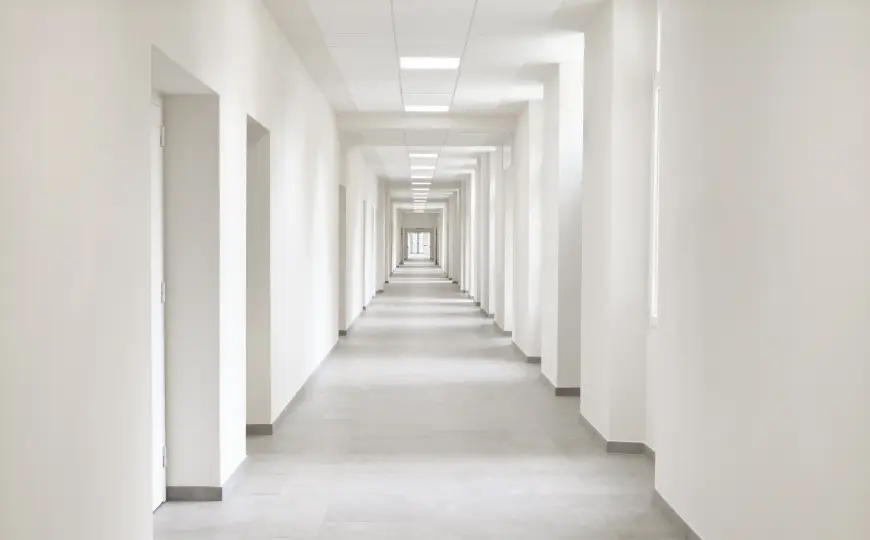
A quiet corridor suggests the stillness and in-between quality often
associated with liminal space.
The Anthropological Origins of Liminality
The concept of liminality begins with Arnold van Gennep. In 1909, van Gennep published Les rites de passage, a study of how societies structure transitions. He described a three-part pattern in rites of passage: separation from the previous state, a middle phase of transition, and incorporation into the new state. The middle phase, the threshold, is where liminality lives.Van Gennep was studying ritual. The liminal period he described was the time when those initiated in a rite of passage were no longer who they had been and had not yet become who they would be. They occupied an intermediate state, suspended between identities, between social roles, between one chapter of life and the next (Ng & Lim, 2018).Victor Turner, an anthropologist working in the 1960s, expanded van Gennep's idea. Turner saw liminality as a condition with its own character: a space where social structure loosened, where normal rules were temporarily suspended, and where something new could emerge. He described liminality as a state of ambiguity and openness, a place where transformation becomes possible precisely because the usual structures are absent (Horrigan, 2021).The idea of liminality has since moved well beyond anthropology. It shows up in architecture, psychology, theology, political theory, and cultural criticism. What holds these uses together is the core recognition: there are thresholds in human experience, and what happens on those thresholds has its own quality, its own logic, its own emotional texture.
Physical Liminal Spaces
The most immediately recognizable liminal spaces are physical places. Hallways, stairwells, waiting rooms, airport terminals, train stations, parking lots, corridors, hotel lobbies. These are transitional spaces, designed to be moved through, places that exist between destinations.What makes them feel liminal is a combination of design and absence. They are built for passage. When you encounter them empty, stripped of the human presence and movement that normally fill them, something shifts. The familiar becomes strange. A school hallway during summer break. A shopping mall after closing. An office building lobby at 3 a.m.The New Yorker's Meng Xiao described these as places that "exist to be traveled through but not lingered in." When you do linger, when the image captures an empty corridor or a vacant parking structure and holds it still, the space takes on a surreal quality. The ordinary becomes uncanny.Abandoned buildings carry this quality with particular intensity. They are liminal in a temporal sense: they belong to a past that has ended and a future that has not been decided. The traces of previous life, peeling paint, left-behind furniture, and a clock stopped on the wall create a sense of suspended time. As one essayist described it, these spaces are "not empty" but "unfinished," holding traces of lives that once moved through them.Architecture has its own relationship to liminality. Thresholds, doorways, corridors, and bridges are all designed as in-between spaces, physical places that mark the boundary between one area and another (Ng & Lim, 2018). These transitional spaces are so ordinary that most people move through them without noticing. The concept of liminality invites a different kind of attention.
Psychological Liminality: The State of Being In Between
Liminal space's meaning extends beyond physical places. A liminal state is a psychological and emotional experience, the felt sense of being in transition.Life is full of these moments. The period after leaving a job and before starting a new one. The months after a significant loss. The transitional times between who you have been and who you are becoming. Graduation, retirement, divorce, migration, illness, recovery. Each of these can carry the quality of liminality: the ground beneath you has shifted, and the new ground has not yet solidified.Thomassen (2009) describes liminality as applicable to both time and space. Single moments can be liminal. So can longer periods, entire seasons of a person's life, where the defining quality is uncertainty and in-between-ness (Thomassen, 2009). The concept of liminality, in this sense, names something that most people recognize from the inside: times of uncertainty where the old map no longer works and the new one has not yet been drawn.William Bridges, a transitions theorist, used the term neutral zone for a similar idea. The neutral zone is the psychological space between an ending and a new beginning, a place that can feel disorienting, empty, and strangely fertile at the same time.What makes psychological liminality significant is its relationship to personal growth. The discomfort of a liminal period, the sense of unease, the loss of familiar structure, is also the condition under which transformation tends to happen. When the usual frameworks fall away, there is space for something new to take shape. This is why many traditions treat the liminal period as sacred. It is uncomfortable. It is also where change lives.
Why Liminal Spaces Feel the Way They Do
There is a particular emotional signature to liminal spaces, both physical and psychological. It is a blend of nostalgia, unease, and a quiet sense of possibility.Sarcinella et al. (2025) describe liminal spaces as "contexts marked by transition and ambiguity" that carry "symbolic openness and narrative fluidity" (Sarcinella et al., 2025). They reflect the experience of change itself. This is part of why images of empty hallways or abandoned malls can trigger a sense of nostalgia. The spaces evoke a feeling of time passing, of being caught between what was and what comes next.The sense of nostalgia is layered. It points backward, toward a past that these spaces seem to hold in suspension. It also points forward, toward an undefined future. Mattei (2022) observed that liminal space images feel "caught between past and present," becoming "impossible to locate" in time (Mattei, 2022). This temporal ambiguity is part of their emotional power.The sense of unease has a simpler explanation. Liminal spaces disrupt expectation. A space designed for human presence, encountered without it, violates a basic assumption about how the world is organized. The result is a mild uncanniness, the feeling that something is slightly wrong in a way that is difficult to name.These two feelings, nostalgia and unease, coexist in liminal spaces. That coexistence is part of what makes them compelling.
Liminal Space Aesthetics and Internet Culture
The idea of liminality has found an unexpected home on the internet. Over the past several years, online communities on Reddit, TikTok, and other platforms have turned liminal space imagery into a distinct aesthetic category.The images are consistent in their mood. Empty pools, vacant school hallways, fluorescent-lit corridors, deserted shopping centers. The photographs are often slightly low-resolution, slightly washed-out, as if taken from a memory. The absence of human presence is the defining visual element.The trend gained particular momentum during the pandemic, a period when public spaces were literally emptied of people, and the experience of liminality, being between a familiar world and an uncertain future, became collective (Xiao, 2021).Tanni (2023) has described how internet image culture itself functions as a kind of liminal space. The constant scroll through fragmented, decontextualized images, the layering of memes and references, and the way meaning shifts and recombines create an experience of perpetual in-between-ness (Tanni, 2023).The Backrooms, a popular internet myth originating from a single image of an empty yellow office space, represents the most developed expression of liminal space aesthetics. The concept describes an infinite, maze-like network of empty rooms that a person can "noclip" into by accident, a space that goes on forever with no exits and no clear purpose. It is liminality taken to its extreme: transition with no arrival.
Liminality as a Lens for Understanding Experience
The concept of liminality offers something useful beyond aesthetics and cultural commentary. It provides a language for experiences that are otherwise difficult to articulate.Much of what is most challenging in human life happens in the spaces between defined states. The period between a diagnosis and a treatment plan. The months between deciding to change careers and actually beginning. The long season after a relationship ends is when the inner world is reorganizing around a new reality.These liminal periods are disorienting. They can also be generative. The absence of structure, the loss of familiar roles and routines, creates a kind of openness. It is in these transitional times that many people report the deepest personal growth, the most significant shifts in how they see themselves and their lives.Depth psychology has long recognized the significance of threshold experiences. The work of moving through a liminal state, tolerating its ambiguity, attending to what emerges, is central to many therapeutic and developmental traditions. The threshold is where transformation happens, precisely because the old structures have fallen away and the new ones have not yet taken their place.
“The learning here is meant to kind of throw you for a loop and let you sit in that, and when you come out the other side, there’s a transformation that’s taken place.”
The study of liminal experience sits at the heart of depth psychology. Thresholds, transitions, and the spaces between defined states are where much of the most significant psychological work takes place. Learning to hold liminal space, for yourself and eventually for others, in a therapeutic or developmental context, asks for a kind of formation that goes beyond conceptual understanding. It is embodied, relational, and sustained over time.Meridian University offers a depth psychology concentration within its Psychology graduate programs. The concentration is grounded in transformative learning and emphasizes practice-based inquiry where students engage with symbolic process, imaginal dimensions of experience, and the depth layers of human development. Coursework integrates depth psychological theory with transpersonal perspectives and contemporary research, preparing graduates for professional practice in psychotherapy, coaching, consultation, and teaching.For those drawn to this kind of inquiry, a conversation with an Admissions Advisor can offer clarity about program pathways and areas of focus.A liminal space is a threshold. What you do there, how you attend to it, shapes what comes next.
Frequently asked questions:
What is the meaning of a liminal space?
A liminal space is a place or state of transition, an in-between zone that exists on the threshold between what came before and what has not yet arrived. The term comes from the Latin word limen, meaning threshold. Liminal spaces can be physical, like hallways, waiting rooms, and train stations, or psychological, like the transitional period between life chapters. The concept originates in Arnold van Gennep's study of rites of passage and has since expanded into psychology, architecture, and contemporary culture. The defining quality of a liminal space is its in-between-ness: the sense of being suspended between two defined states.
What are examples of liminal spaces?
Examples of liminal spaces include both physical places and life experiences. Physical liminal spaces include hallways, stairwells, parking lots, hotel corridors, airport terminals, train stations, waiting rooms, and abandoned buildings. These are transitional spaces designed to be passed through. Psychological liminal spaces include the period after a job loss, the months following a significant life change, and the time between deciding to make a transition and arriving at the new chapter. What connects them is the quality of being in between, no longer in the previous state and not yet in the next.
What is the most famous liminal space?
The most widely recognized liminal space in internet culture is the Backrooms, an image of an empty, fluorescent-lit office space with yellowish carpet that became the basis for an elaborate online mythology. The image evokes an infinite, maze-like network of empty rooms with no exits, representing liminality taken to its extreme. Beyond internet culture, some of the most culturally resonant liminal spaces include empty school hallways, deserted shopping malls, and hotel corridors, images that gained widespread attention through Reddit communities and social media during the early 2020s.
References
Fawcett, J. (2022, February 24). The pull of abandoned spaces. CrimeReads.
Horrigan, M. (2021). The liminoid in single-player videogaming: A critical and collaborative response to recent work on liminality and ritual. Game Studies, 21(2).
Mattei, Z. (2022, August 11). The liminality aesthetic. Elephant Magazine.
Ng, V., & Lim, J. P. (2018). Tracing liminality: A multidisciplinary spatial construct. Journal of Engineering and Architecture, 6(1), 76–90.
Sarcinella, E. D., Liedgren, J., & Chirico, A. (2025). Life in transition: Nostalgia as change-related emotion. Frontiers in Virtual Reality, 6, 1629484.
Tanni, V. (2023). The backroom of internet aesthetics and liminal spaces. KoozArch.
Thomassen, B. (2009). The uses and meanings of liminality. International Political Anthropology, 2(1), 5–27.
Xiao, M. (2021, April 16). The pleasant head trip of liminal spaces. The New Yorker.
Learn More
Interested in learning more about the programs at Meridian?
 Michelle G.MA in Psychology StudentWatch Michelle G., run time 1:34